Dachshund Colors and Coat Types, Explained
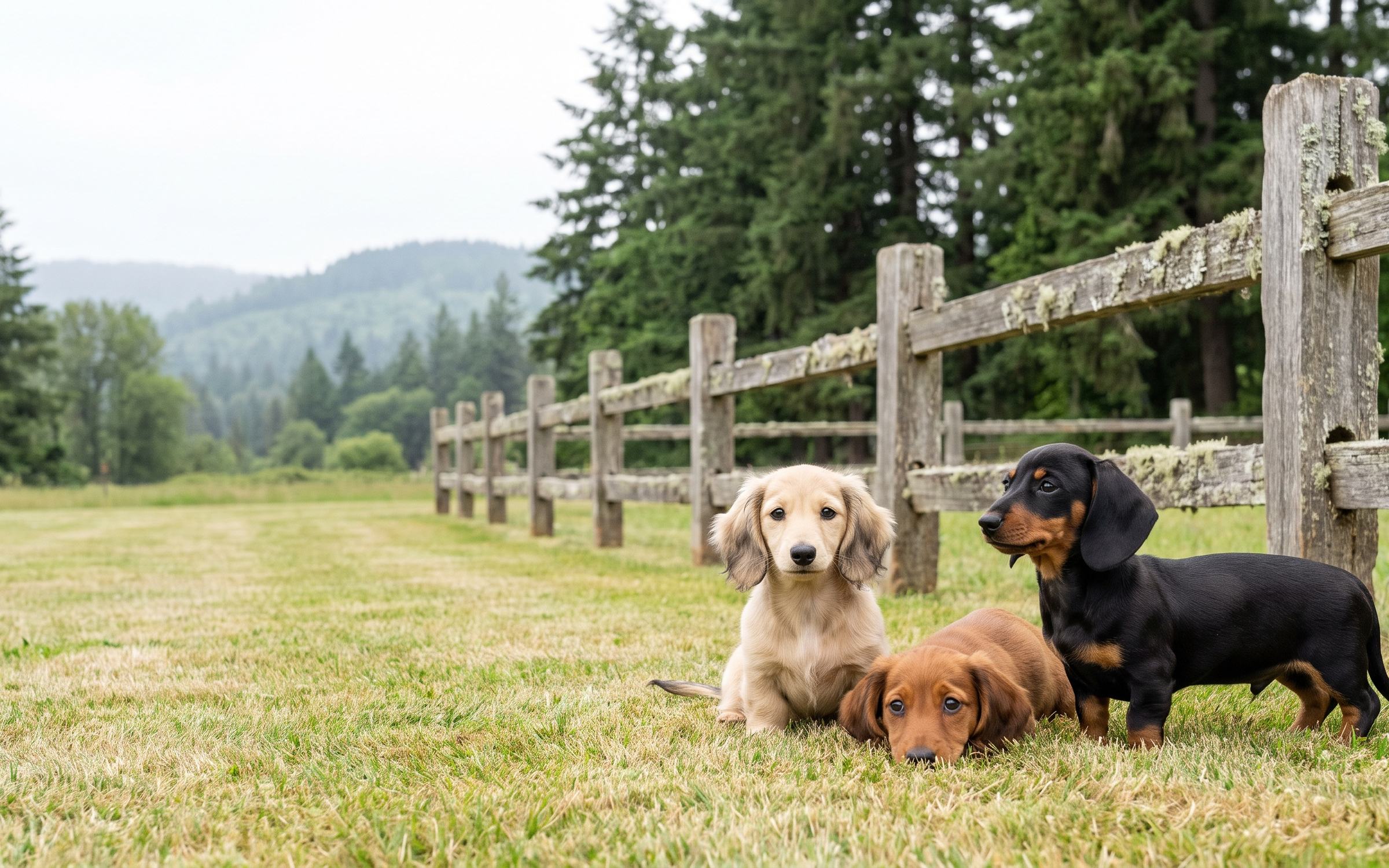
Dachshunds come in three coats and a long list of colors and patterns. Knowing which is which helps you read a listing accurately, ask better questions, and spot the one pairing a careful breeder will not make.
Almost every question we get about our available Dachshund puppies is really a question about coat or color. It is the first thing people notice and the part of a listing that is most often described loosely. This is the plain version.
The three coats
The American Kennel Club recognizes three coat varieties, and all three can appear in the same breed line.
- Smooth: short, close and glossy. The lowest-maintenance coat of the three. A rubber curry mitt once a week is genuinely enough. Smooth Dachshunds feel the cold more than the other two, so a coat in winter is practical rather than decorative.
- Longhaired: soft and slightly wavy, with feathering on the ears, chest, legs and tail. The feathering is where mats form, so plan on a few minutes of brushing most days and a proper comb-through weekly.
- Wirehaired: a dense, harsh outer coat with a softer undercoat, plus the bushy eyebrows and beard the variety is known for. It needs hand-stripping or a groomer who knows wire coats a few times a year. Clipping a wire coat softens it permanently, which is worth knowing before the first appointment.
Coat variety and size are independent. A miniature Dachshund can be smooth, longhaired or wirehaired, and so can a standard. If a listing says “mini long hair”, that is two separate facts about the same dog.
The colors you will actually see
Dachshund color is described in two parts: the base color, and the pattern laid over it. Base colors include red, cream, black and tan, chocolate and tan, blue and tan, and fawn (often called Isabella) and tan. Wirehaired Dachshunds add wild boar, a banded mix of dark and light hairs that reads as a warm grey-brown.
| Color | What it looks like | Worth knowing |
|---|---|---|
| Red | Ginger through to deep mahogany | The most common Dachshund color by a wide margin |
| Cream | Pale gold to near-white | English cream lines tend to hold the pale tone into adulthood |
| Black and tan | Black body with tan points on face, chest and feet | The classic hound marking |
| Chocolate and tan | Warm brown body with tan points | Usually comes with lighter eyes and a brown nose |
| Blue and tan | Diluted black, a soft slate grey | Dilute coats can be prone to colour-dilution alopecia |
| Wild boar | Banded hairs, grey-brown overall | Wirehaired only |
English cream, and what the word means
“English cream” describes a cream longhaired Dachshund descended from English show lines, which typically carry the recessive chinchilla gene and keep a pale, even coat as adults. An American cream is the same color from different lines and often shows more shading. Neither is a separate breed and neither is inherently healthier. The label is about pedigree, not quality, so treat a price premium attached to it with the same scepticism you would give any other label.
Patterns: dapple, piebald, brindle and sable
Dapple is the Dachshund name for merle: irregular lighter patches over the base color. A silver dapple is dapple over black, a blue dapple over a diluted base, a chocolate dapple over brown. One copy of the gene produces a healthy, normally-marked dog.
Piebald is a separate gene that produces white areas with colored patches, usually a white chest, collar and feet. A piebald dog can also be dapple, which is where descriptions start to stack up.
Brindle lays dark tiger-stripes over a red or tan base. Sable gives each red hair a dark tip, so the dog looks red with a dark overlay that often fades with age.
Breeding two dapple parents together can produce puppies with two copies of the gene. Those dogs carry a high risk of deafness, blindness and malformed or missing eyes. It is an avoidable outcome, and a breeder who offers double dapple puppies, or who cannot tell you whether both parents are dapple, has told you what you need to know. Everpine does not breed dapple to dapple.
Puppy color is not final color
Dachshund coats change. Red puppies often darken. Sables lose much of their dark overlay. Cream puppies frequently lighten through the first year, and a longhaired puppy will not have its adult feathering until somewhere between one and two years old. Every color description on our puppy cards describes the puppy as they are now, which is the only honest way to write it.
- Three coats, independent of size. Smooth, longhaired and wirehaired each groom differently, and any of them can be miniature or standard.
- Color is base plus pattern. Most confusing listings are just those two facts written as one word.
- Double dapple is a real risk. Ask whether both parents are dapple before anything else.
- Expect change. Coat color and length both shift well into the second year.
If you want to see the coats and colors side by side rather than on a chart, the current group is on the Dachshund puppies page, where coat and color are both filters. For temperament and the back care that matters more than any of this, read the Dachshund breed guide, and for what a puppy actually costs, see our Dachshund price guide.
Coat and color descriptions are general and change as a puppy matures. For questions about skin, coat or inherited eye conditions, your veterinarian is the right source.
Using coat descriptions when browsing actual puppies
A “dapple” label describes a pattern; it does not tell you everything about a Dachshund’s genetics or future health. Long-haired, smooth and wire-haired describe coats, not separate sizes or temperaments. When you read a puppy listing, look at the actual coat and parent information and ask questions rather than treating color as a shortcut for quality.
If you have a preferred coat type, browse the current puppies, compare each Dachshund’s listed details and inquire about anything you cannot tell from the photographs. Health, appropriate breeding practices and suitability for your household matter more than a rare color.
More from the Everpine Journal
- Breeds
How Big Do Cavapoos Get? Full-Grown Size Explained
4 min read - Breeds
How Big Do Maltipoos Get? Full-Grown Size Explained
4 min read - Breeds
Maltipoo Colors, and Why They Change
4 min read