Crate Training Without the Stress: A Gentle 7-Day Plan
A crate is not a cage and it is not a punishment. Done properly, it is the one place in the house your puppy can genuinely switch off, and it makes house training, travel and rest dramatically easier.
Our puppies meet a crate long before they meet you. They sleep in raised beds with soft, washable bedding and quiet, protected spaces, so the idea of a small den where nothing is expected of them is already familiar. Your job at home is to keep that association intact.
Why bother
- House training. Puppies avoid soiling where they sleep, which gives you a reliable structure to work with.
- Real rest. Puppies need sixteen to twenty hours of sleep a day and will not take it in a busy room.
- Safety. Somewhere secure for the puppy to be when you cannot supervise, which is most of the reason puppies eat things they should not.
- Later life. Vet stays, travel, grooming and recovery from any procedure are all far less stressful for a dog who finds a crate ordinary.
Choosing the crate
Buy one big enough for your puppy to stand, turn around and lie down fully stretched, and no bigger. A crate with acres of spare room simply becomes a bedroom with a bathroom attached. Most crates come with a divider panel so you can buy for the adult size and expand as your puppy grows.
Place it somewhere with people, not somewhere isolated. A corner of the living room during the day and beside your bed at night works for most households.
The crate is never used as punishment. The puppy is never let out while actively crying, if you can avoid it. And nothing goes in the crate that can be shredded and swallowed.
The seven-day plan
Each session below is short. Several short sessions beat one long one, every time.
Day 1: make it furniture
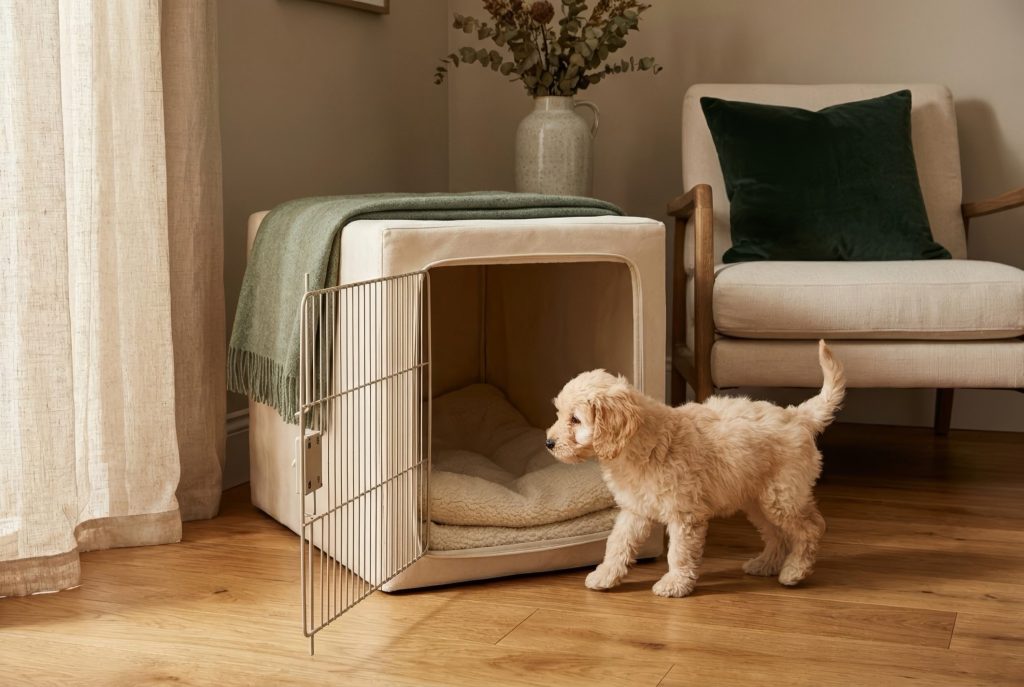
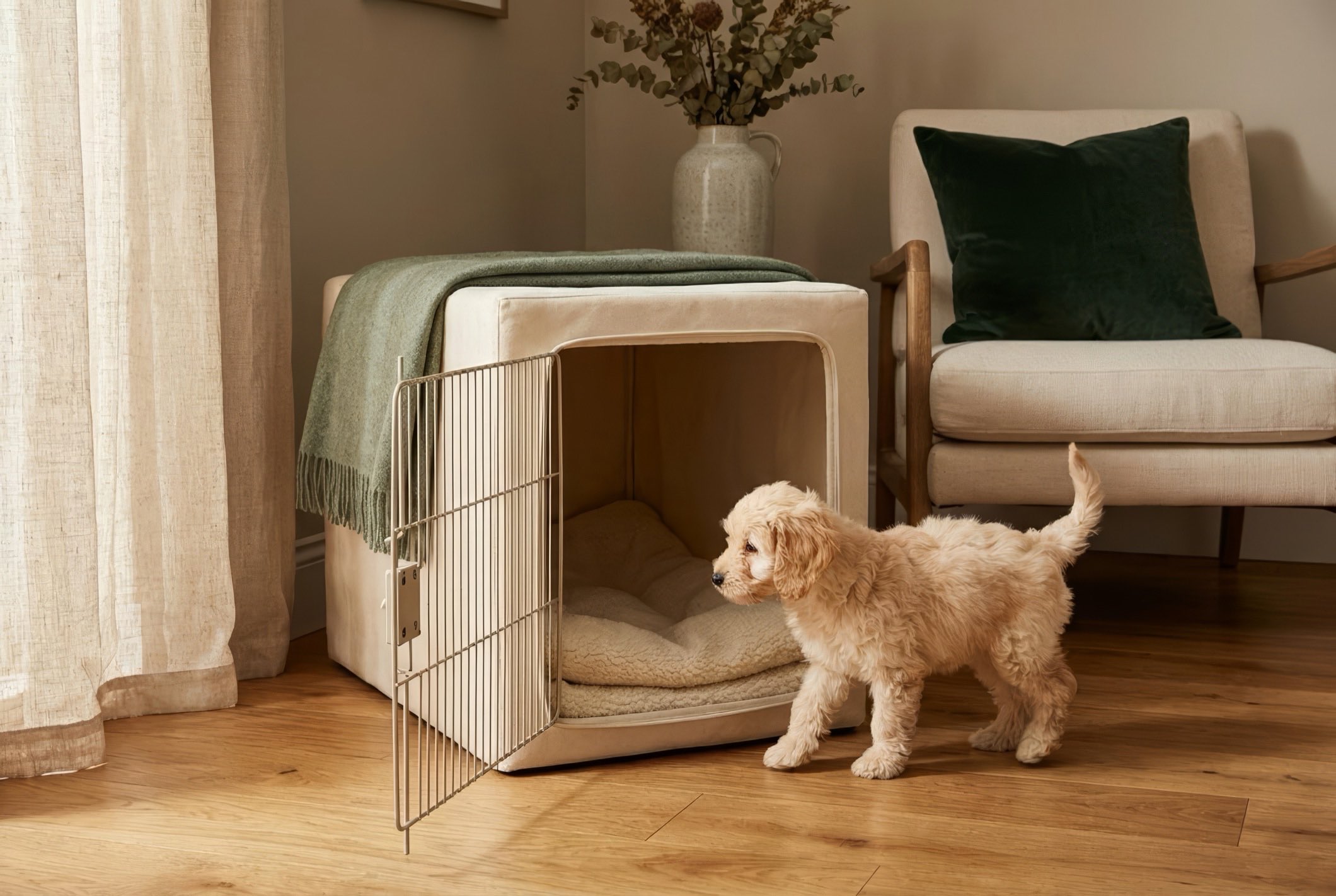
Door open, propped so it cannot swing shut. Toss a treat just inside, let your puppy walk in and straight back out. Repeat a handful of times. Feed one meal with the bowl just inside the door. Do not close anything.
Day 2: meals inside
Move the bowl fully into the crate. While your puppy eats, sit nearby. Once they are eating comfortably inside, gently close the door for the duration of the meal and open it as they finish, before they think to ask.
Day 3: short closed intervals
Close the door for thirty seconds while you sit beside the crate, then open it calmly. Build to two or three minutes across several sessions. Keep it boring: no fuss on the way in, no party on the way out.
Day 4: leave the room
Same short intervals, but step out of the room for ten to twenty seconds and return before your puppy has time to worry. Return while they are quiet, not after they have started to complain.
Day 5: attach it to naps
Start putting your puppy in the crate when they are already tired, after play and a potty trip. This is the single most useful habit in the plan: the crate becomes the place sleep happens rather than the place fun stops.
Day 6: stretch the time
Work up to twenty or thirty minutes while you move around the house doing normal things. A safe chew or a food-stuffed toy helps, provided you can supervise.
Day 7: a real absence
Leave the house properly for fifteen to twenty minutes. No emotional goodbye, no emotional return. Come back in, ignore the crate for a minute, then let your puppy out calmly.
Boring arrivals and boring departures are what teach a puppy that your leaving is not an event.
Night-time
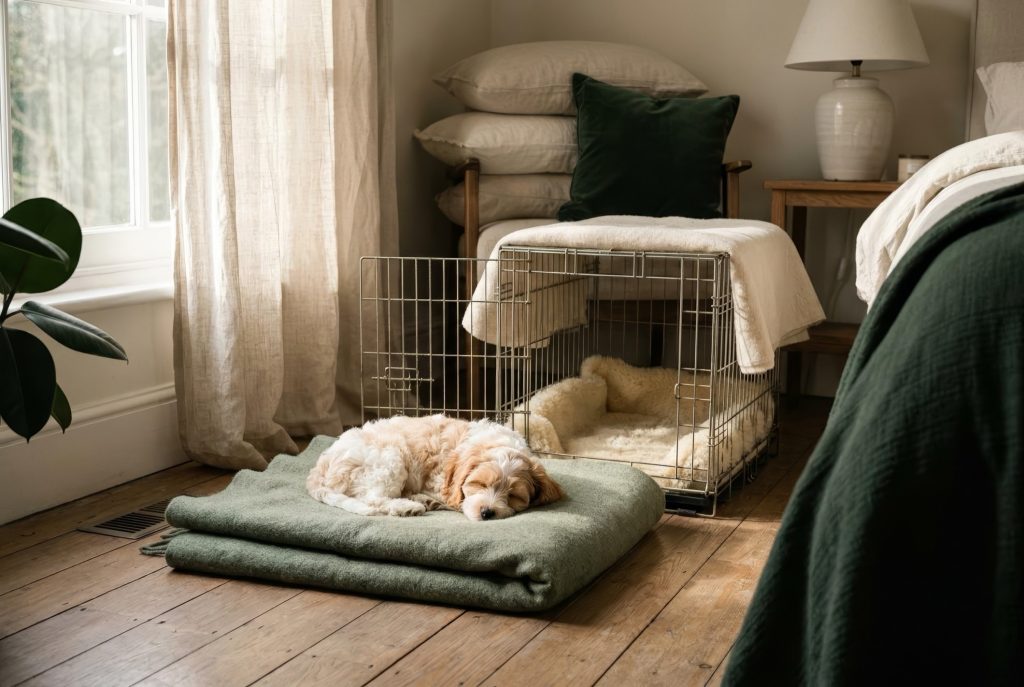
Nights are their own project. For the first week or two, put the crate beside your bed. Being able to hear and smell you settles most puppies faster than anything else.
- Last meal roughly three hours before bed; lift the water bowl about an hour before.
- Final potty trip immediately before lights out, on lead, with no play attached.
- Expect one or two wakings in the first weeks. Take your puppy out quietly, no talking, no toys, straight back into the crate.
- Once your puppy is reliably dry overnight, you can move the crate gradually towards its permanent spot, a few feet at a time.
How long is too long
A rough guide for daytime is one hour per month of age, up to a maximum of about four hours for an adult dog. An eight-week-old puppy should not be crated for more than an hour or so at a stretch during the day, and needs a potty trip immediately on coming out.
| Age | Daytime maximum |
|---|---|
| 8 to 10 weeks | About 1 hour |
| 11 to 14 weeks | 2 to 3 hours |
| 15 to 16 weeks | 3 to 4 hours |
| 17 weeks + | 4 hours, with a proper break |
Common mistakes
- Using the crate as a consequence. One angry “get in your crate” undoes a fortnight of work.
- Opening the door mid-protest. Wait for a pause, even two seconds of quiet, and open then.
- Making exits exciting. Big greetings on release teach the puppy that being let out is the best moment of the day.
- Going too fast. If your puppy struggles at a step, go back one step and spend an extra day there.
- Crating instead of exercising. The crate supports a good routine; it does not replace walks, play or company.
If it is not working
Persistent distress (panting, drooling, frantic escape attempts, or crying that escalates rather than settles) is different from ordinary protest and should not be waited out. Pause the plan and speak to your veterinarian or a qualified positive-reinforcement trainer. It is a solvable problem, but not one to push through.
- Right size, right place: big enough to stand and stretch, positioned where the family is.
- Feed meals inside before you ever close the door.
- Attach the crate to naps, not to the end of playtime.
- One hour per month of age is a sensible daytime ceiling.
- Never a punishment, and never a dramatic release.
This article is general guidance based on how we raise our puppies. Signs of genuine distress should be discussed with your veterinarian or a qualified trainer rather than managed alone.
More from the Everpine Journal
- Training
Socializing Your Puppy in the First Twelve Weeks
2 min read - Training
House Training a Small Breed: A Patient, Practical Plan
2 min read - Training
Teaching Your Puppy to Be Alone: Preventing Separation Anxiety
2 min read